
Assertive Communication Skills: The Key to Confidence and Respect
Lesson 1: Listen. Watch. Learn. — The Power of Assertive Communication
Assertive communication helps you express your thoughts, needs, and feelings clearly, confidently, and respectfully. It’s about finding that balance — standing your ground while still showing understanding and empathy.
Through our podcast and video lesson, you’ll discover what assertive communication really means, why it matters, and how to start building this skill today.




Lesson 2: Assertive Communication Skills — The Key to Confidence and Respect
Click the play button to begin. Explore deeper insights, advanced strategies, and practical tools to turn understanding into influence.
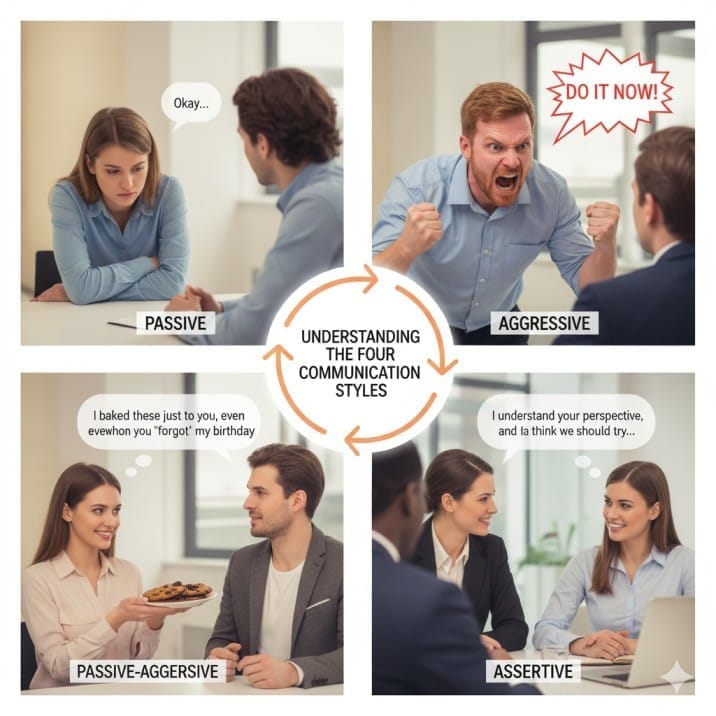
Understanding the Four Communication Styles
Before mastering assertiveness, it’s important to understand the four main communication styles: passive, aggressive, passive-aggressive, and assertive. Each one reflects a different way of expressing thoughts, feelings, and needs.
Passive Communication
Definition: Avoiding the expression of one’s thoughts and needs.
Characteristics:
Quietly accepting others’ opinions
Avoiding conflict or confrontation
Reluctance to speak up
Driven by: Fear, lack of confidence, and the desire to keep peace.
Consequences: Needs go unmet because others can’t read your mind. Over time, this can lead to frustration, resentment, and low self-esteem.

Aggressive Communication
Definition: A dominating, confrontational way of expressing thoughts and emotions.
Characteristics:
Blaming and attacking others
Finger-pointing, interrupting, or using a harsh tone
Overusing “you” statements (“You always…”, “You never…”)
Driven by: A desire for control and self-focus.
Consequences: Others feel defensive, intimidated, or disrespected. The message gets lost in the emotional noise.
Passive-Aggressive Communication
Definition: Expressing anger or frustration indirectly instead of addressing it openly.
Characteristics:
Sarcastic remarks or grumbling
Gossiping or talking behind people’s backs
Acting like a victim or using silent treatment
Assertive Communication
Definition: Expressing your thoughts and needs clearly, calmly, and respectfully — while valuing others’ opinions too.
Characteristics:
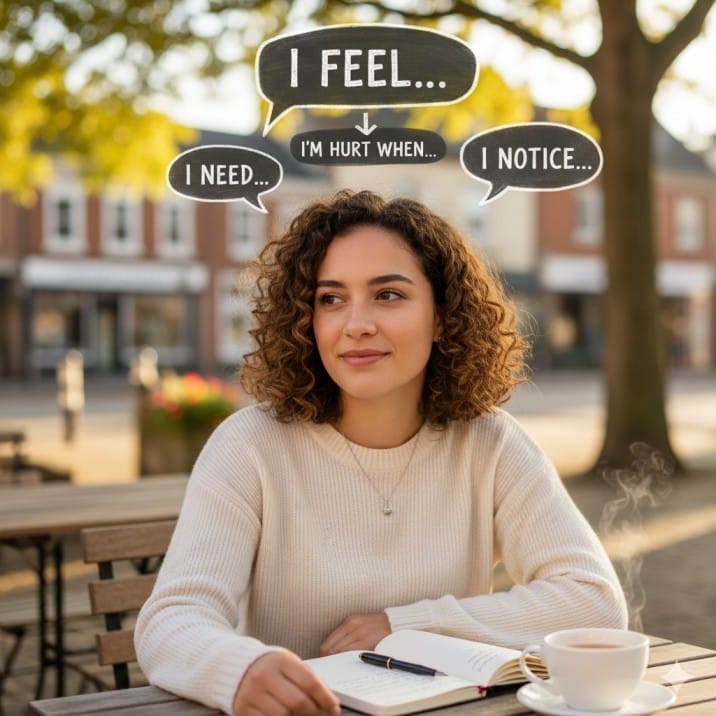
Using “I” statements (“I feel,” “I think,” “I need”)
Staying calm and composed
Listening actively to others
Driven by: Mutual respect and a genuine desire to understand.
Benefits: Messages are more likely to be heard and respected. Assertive communicators maintain healthy relationships built on clarity, honesty, and trust.
How to Communicate More Assertively
Becoming assertive doesn’t happen overnight — it takes practice and self-awareness. Here are four steps to help you communicate with confidence and respect.


Prepare Your Message in Advance
Don’t rush into conversations when you’re emotional.
Stay calm: Take time to cool off before speaking.
Plan your message: Write it out, read it aloud, and revise it until it feels clear and neutral.
Practice: Rehearse your message so you can speak with sincerity and confidence.
Say What Needs to Be Said — Directly and Respectfully
Focus on what you need to say, not on controlling how others react.
Stick to facts, not accusations.
Respect the other person’s right to share their perspective.
Stay calm, even if the conversation gets uncomfortable.
Use “I” Language
“I” statements help express how you feel without sounding blaming or defensive.
✅ Example: “I feel overwhelmed by the amount of work on my plate.”
🚫 Avoid: “You’re giving me too much work.”
This approach keeps communication open and non-confrontational. It encourages the other person to listen and collaborate instead of reacting defensively.
Be a Good Listener
Assertive communication isn’t just about talking — it’s also about listening.
Make eye contact and use encouraging gestures.
Ask thoughtful questions to show genuine interest.
Allow the other person space to speak without interruption.
Listen patiently before responding.
Why it matters: Good listening demonstrates mutual respect and sets a positive tone for healthy dialogue.
Final Thoughts
This wraps up our short lesson on Reflective & Growth-Focused learning.
If some concepts still feel unclear, you’re encouraged to enrol in the full course for a deeper and more structured understanding.
Continue Your Journey
Take your learning to the next level with the full course — Communication Mastery: From Listening to Leadership.
In this comprehensive program, you’ll gain a complete understanding of effective communication strategies that build influence, trust, and leadership presence.
Kindly view the course profile and enrol to unlock the full experience.

Get in touch with our expert team today — we’re just a call or WhatsApp away!



|
Naomi Venter
Meet. Create. Grow.
|



|
|
Samuel J. V. Vuuren
Meet. Create. Grow.
|

|
|
Nelly Agboola
Meet. Create. Grow.
|

|
|
Zurica Mitchley
Meet. Create. Grow.
|



GET IN TOUCH
Contact Us
Contact Us
Book your viewing today and discover more in person.
Open Hours
Mon-Fri: 9 AM – 6 PM
Saturday: 9 AM – 4 PM
Sunday: Closed
Contacts
267 Oak Avenue, Ferndale, Johannesburg, South Africa.
Email: team@synchub.space
Visit Us
SyncHub Co-working Space
267 Oak Avenue, Ferndale, Johannesburg, South Africa