
(Digital communication Misery)
Lesson #1: Listen. Watch. Learn. — The Power of Assertive Communication
Think about it — every text you send, every video you stream, every call you make travels through invisible digital networks working behind the scenes. In our connected world, digital communication systems power it all.




Lesson#2: Communication Misery — From Listening to Leadership
Click the play button to begin. Explore deeper insights, advanced strategies, and practical tools to turn understanding into influence.
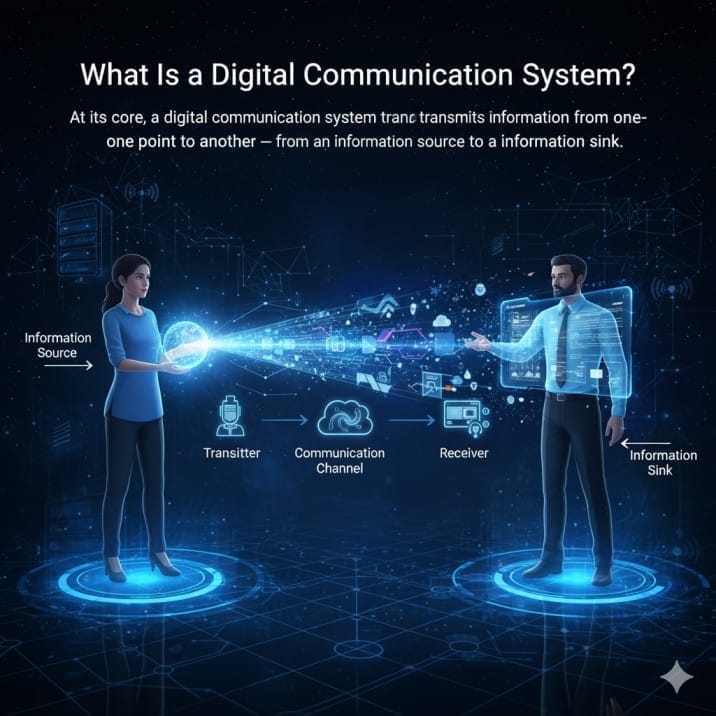
What Is a Digital Communication System?
At its core, a digital communication system transmits information from one point to another — from an information source to an information sink. Think of it as a chain that carries your message from where it’s created to where it’s received.
A typical digital communication system includes:
Information Source: The origin of information (speech, text, music, video).
Input Transducer: Converts information into electronic signals (microphone, camera, keyboard).
Transmitter: Converts electrical signals into waveforms for transmission.
Channel: The physical medium (wire, fiber, air, or water) that carries the signal.
This course — and this article — primarily focus on the transmitter, channel, and receiver, which together form the heart of any digital communication system.
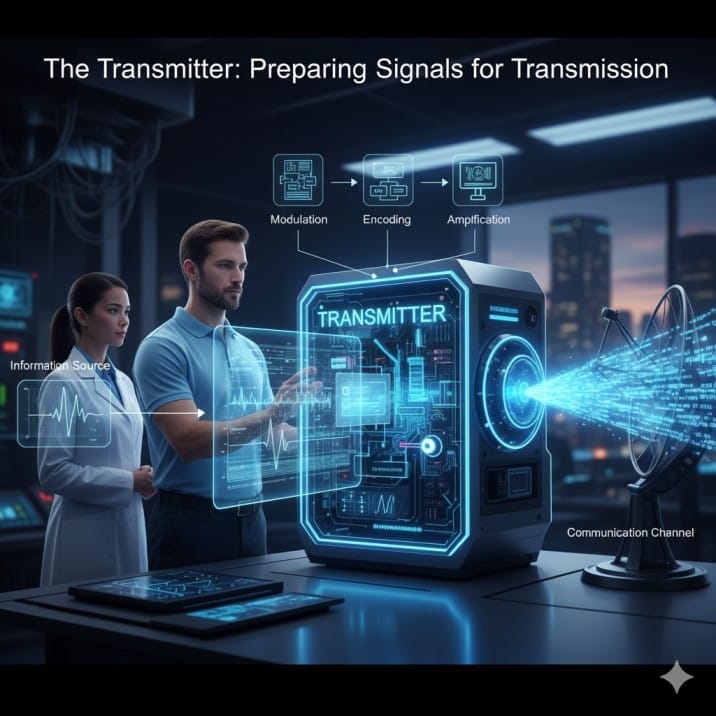
The Transmitter: Preparing Signals for Transmission
The transmitter plays a critical role by converting electrical signals (often analog) into a form suitable for transmission. Because low-frequency signals (like speech) can’t travel efficiently through air or cables, transmitters use a process called frequency translation to shift these signals into higher, more suitable frequencies.
Key Functions of a Transmitter
Multiplexing: Allowing multiple signals to share the same channel.
Pulse Shaping: Ensuring efficient transmission within bandwidth limits.
Modulation: Encoding information onto a carrier wave.
Amplification and Filtering: Strengthening and refining the signal.
Each of these steps ensures that your message can travel long distances without distortion or loss.
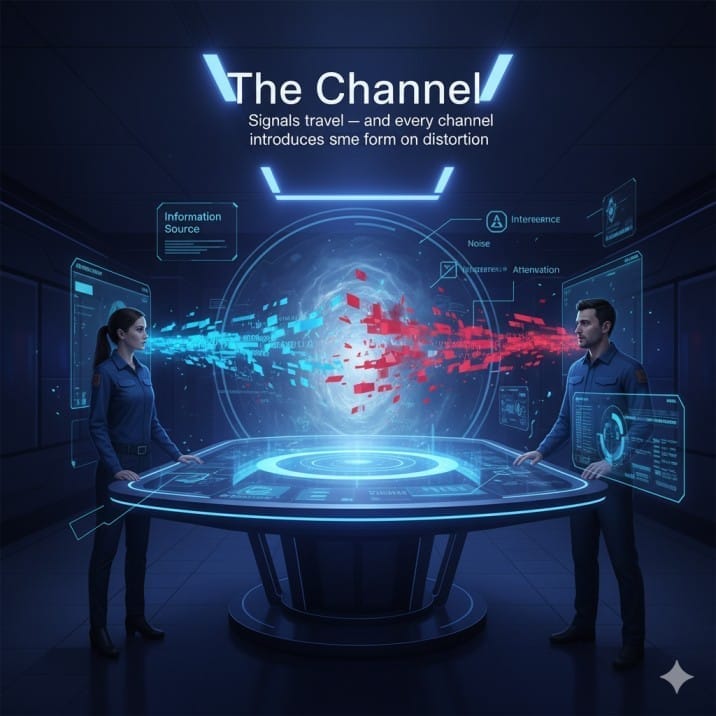
The Channel: The Signal’s Journey
The channel is the medium through which signals travel — and every channel introduces some form of distortion. Understanding channels helps engineers design systems that reduce noise and maximize performance.
Types of Communication Channels
Wireline Channels
Optical: Transmit light through fiber optics — ideal for high-speed internet.
Electrical: Use voltages and currents through cables like twisted pair or coaxial cables.
Wireless Channels
Radio: Transmit signals through electromagnetic waves — used in Wi-Fi, radio, and mobile communication.
Optical Wireless: Use infrared or visible light in open air.
Acoustic: Transmit sound waves — especially useful for underwater communication.
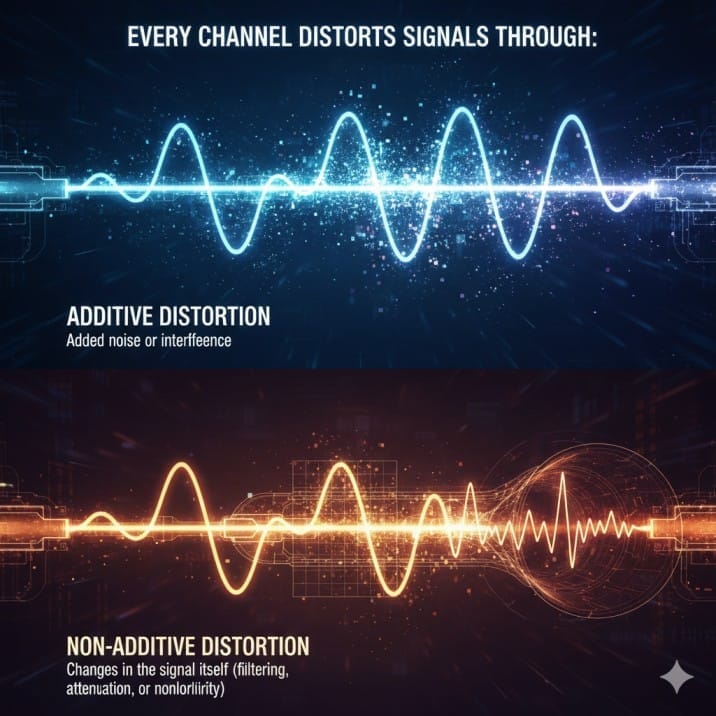
Channel Distortion: Why Signals Change
Every channel distorts signals through:
Additive Distortion: Added noise or interference.
Non-Additive Distortion: Changes in the signal itself (filtering, attenuation, or nonlinearity).
Mathematically, engineers model channels using equations such as:
Additive Noise Channel: R(t) = A * S(t) + N(t)
LTI (Linear Time-Invariant) Channel: R(t) = S(t) * H(t) + N(t)
LTV (Linear Time-Variant) Channel: R(t) = S(t) * H(t, τ) + N(t)
These models help predict and correct how a channel alters the transmitted signal.
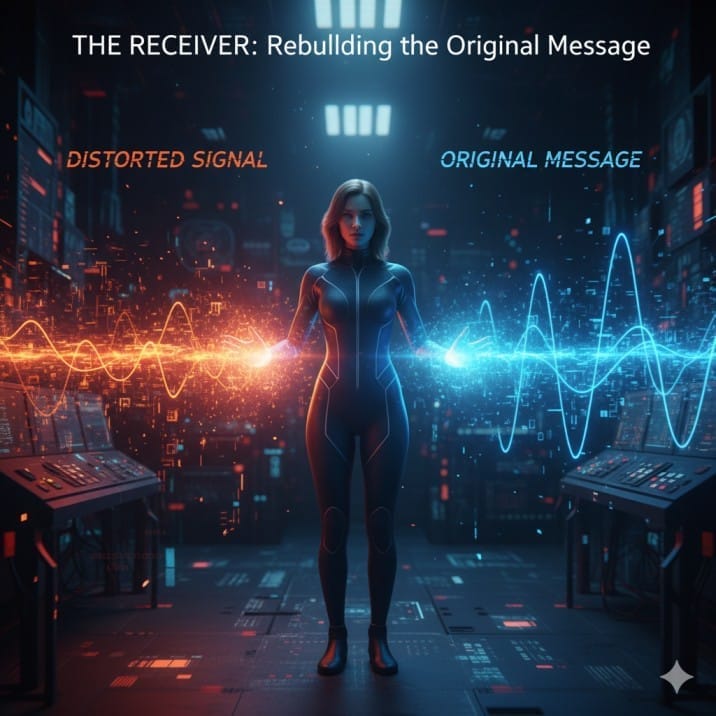
The Receiver: Rebuilding the Original Message
The receiver is where the magic happens — it takes the distorted signal from the channel and reconstructs the original message.
Main Functions of a Receiver
Frequency Translation: Bringing the signal back to its baseband form.
Amplification & Filtering: Cleaning and boosting the signal.
Demodulation: Extracting the encoded information.
Demultiplexing: Separating combined signals.
Decoding & Error Correction: Identifying and fixing transmission errors.
Reconstruction: Rebuilding the signal into its final form (audio, text, or video).
Why Digital Communication Is Better Than Analog
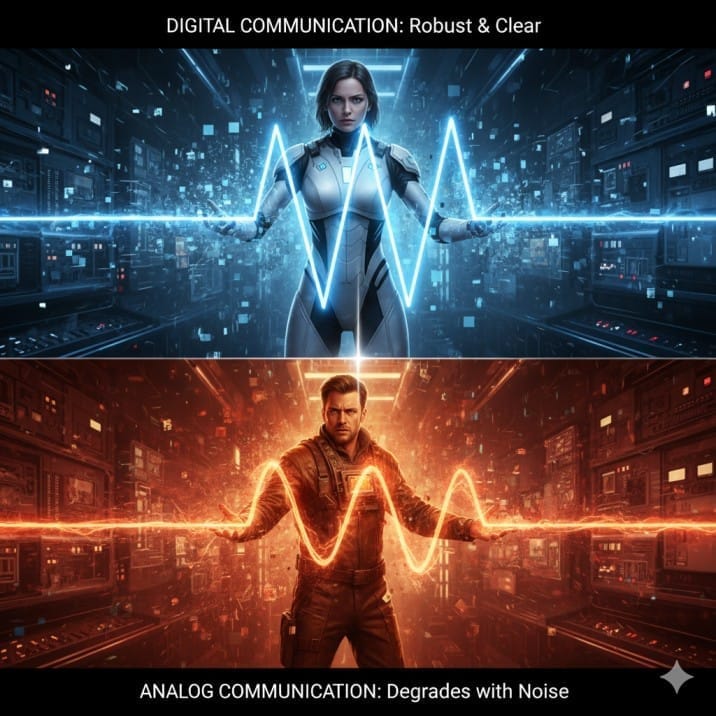
In analog communication, the receiver must reproduce the exact waveform sent by the transmitter. Once noise enters the signal, it’s nearly impossible to remove it completely.
In digital systems, however, the receiver only needs to recognize whether a bit is a “1” or a “0.” This makes digital communication far more resilient to noise and interference.
Performance Metrics:
Analog Systems: Measured by Signal-to-Noise Ratio (SNR).
Digital Systems: Measured by Bit Error Rate (BER) — how often a receiver misreads a bit.
Digital communication doesn’t need to recreate the signal perfectly — it just needs to recognize it accurately. This fundamental advantage makes digital systems faster, clearer, and more reliable.
You’re Almost There!
The video lesson below is your final step — and it’s designed to help you bring everything you’ve learned together. Watch it carefully to deepen your understanding and see how all the pieces fit. You’ve come this far — now finish strong!
This is part of a full course!
Communication Misery: From Listening to Leadership — the complete version of Mastering Communication Misery.
Enrol now for deeper insights, advanced strategies, and practical tools to take your communication from understanding to influence.

Get in touch with our expert team today — we’re just a call or WhatsApp away!



|
Naomi Venter
Meet. Create. Grow.
|



|
|
Samuel J. V. Vuuren
Meet. Create. Grow.
|

|
|
Nelly Agboola
Meet. Create. Grow.
|

|
|
Zurica Mitchley
Meet. Create. Grow.
|


GET IN TOUCH
Contact Us
Contact Us
Book your viewing today and discover more in person.
Open Hours
Mon-Fri: 9 AM – 6 PM
Saturday: 9 AM – 4 PM
Sunday: Closed
Contacts
267 Oak Avenue, Ferndale, Johannesburg, South Africa.
Email: team@synchub.space
Visit Us
SyncHub Co-working Space
267 Oak Avenue, Ferndale, Johannesburg, South Africa